

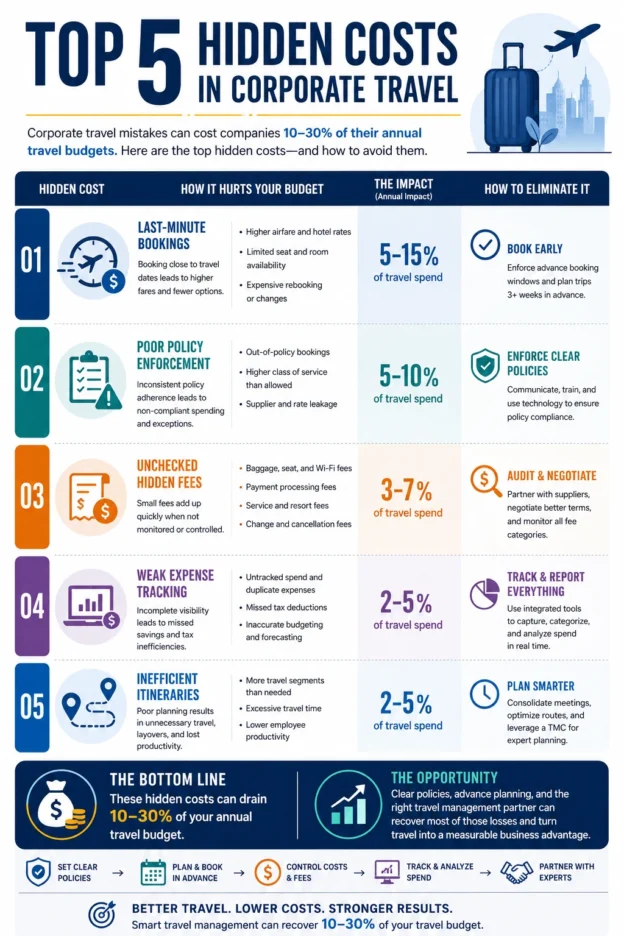
Corporate travel mistakes such as poor policy enforcement, last-minute bookings, unchecked hidden fees, and weak expense tracking can cost companies 10 to 30 percent of their annual travel budgets. Clear policies, advance planning, and the right travel management partner can recover most of those losses and turn travel into a measurable business advantage.
Business trips fuel growth, but they also burn through budgets faster than most finance teams realize. According to the Global Business Travel Association (GBTA) Business Travel Index Outlook, global business travel spending crossed USD 1.48 trillion in 2024, with a meaningful share lost to avoidable inefficiencies. Govan Travels has observed how minor booking oversights quietly snowball into six-figure annual losses across mid-sized Indian enterprises. Knowing the common pitfalls before approving the next trip protects both budgets and employee productivity.
What are the Most Common Corporate Travel Mistakes?
Most organizations repeat the same handful of errors that quietly inflate corporate travel spend each quarter. Recognizing these patterns early is the first step toward fixing them.
- Booking flights and hotels too close to departure dates
- Allowing employees to bypass approved corporate travel policies
- Skipping travel insurance for international trips
- Failing to track receipts and expense reports in real time
- Ignoring loyalty programs and pre-negotiated corporate rates
These small oversights add up quickly, often costing mid-sized firms upwards of INR 10 lakh in preventable losses each financial year.
How Much Do Poor Travel Decisions Cost Companies Each Year?
A Deloitte study on corporate spending found that organizations lose between 10 and 30 percent of their travel budgets to inefficient booking practices and policy non-compliance. For a company spending INR 2 crore on annual travel, that translates to INR 20 to 60 lakh in avoidable losses. The hidden cost extends beyond cash, since rushed bookings often mean longer layovers, missed client meetings, and exhausted employees who underperform during critical engagements.
Why Do Corporate Travel Policies Often Fail to Save Money?
Most travel policies sit in shared drives, unread and outdated, while employees book through personal accounts for convenience or reward points. Research published in the Harvard Business Review notes that policies without enforcement mechanisms typically deliver less than half of their projected savings. Vague guidelines around cabin class, hotel star ratings, and meal allowances create grey zones that drive up reimbursements. A clear, regularly refreshed, and digitally enforced corporate travel policy is the difference between a document and a real cost-control tool.
What Hidden Fees Drain Corporate Travel Budgets the Most?
Sticker prices on flights and hotels rarely reflect the final invoice. Several add-on charges quietly inflate corporate travel costs across nearly every trip.
- Last-minute change and cancellation penalties
- Baggage and seat selection fees on budget carriers
- Hotel resort fees, parking, and in-room Wi-Fi charges
- Foreign exchange markups on corporate credit cards
- Ground transport surge pricing during peak hours
A quarterly audit of these line items often surfaces savings worth several lakhs that finance teams previously wrote off as fixed costs.
How Can Businesses Reduce Last-Minute Booking Costs Effectively?
Data from the Airlines Reporting Corporation shows that domestic airfares booked within seven days of travel can cost up to 70 percent more than fares booked three weeks in advance. A centralized booking calendar, mandatory advance approval windows, and pre-negotiated corporate rates with airlines and hotel chains dramatically cut these surcharges. Pairing internal discipline with a travel management partner that monitors fare drops adds a second layer of measurable savings.
What Should Companies Look for in a Corporate Travel Partner?
The right corporate travel partner does more than book tickets, acting as a cost-control and risk-management extension of the finance team. Choosing carefully prevents recurring budget leakage.
- 24/7 emergency support across time zones
- Pre-negotiated corporate rates with airlines and hotel groups
- Real-time expense reporting and policy compliance tools
- Duty-of-care services and traveler safety tracking
- Transparent fee structures with no hidden markups
A travel partner aligned with company goals turns corporate travel from a quarterly cost headache into a strategic business asset.
References
- Global Business Travel Association (GBTA), Business Travel Index Outlook 2024
- Deloitte Insights, Corporate Travel Study on cost leakage and policy compliance
- Harvard Business Review, research on enforcement and savings outcomes in corporate travel policies
- Airlines Reporting Corporation (ARC), data on advance-purchase airfare pricing trends