

Tag Archives: corporate travel management

Corporate Tour Package Solutions for Team Building, Retreats & Business Travel

Corporate Tour Package Solutions for Team Building, Retreats & Business Travel

A corporate tour package bundles travel, stay, transfers, meeting space, and group activities for a company into one managed booking. It suits team building offsites, leadership retreats, incentive trips, and routine business travel. The main reason firms use one is time: a single coordinator handles 40 itineraries instead of 40 people booking their own. Costs in India typically run from ₹4,000 per person for a one-day local offsite to well past ₹40,000 per person for multi-day or international programs. 

Booking travel for one person is annoying. Booking it for thirty, with three flight connections, a venue that needs a projector and vegetarian catering, and one finance head who wants a single invoice, is a part-time job nobody on the team asked for. That is the gap a corporate tour package fills. Govan Travels, a unit of the Dalmia Bharat Group and one of India’s older IATA-accredited agencies, sits in this category alongside other established corporate travel operators. The sections below cover what these packages actually include, when they make sense, and what to check before signing one. 

What Is a Corporate Tour Package and What Does It Include? 

A corporate tour package is a pre-arranged travel program built around a company’s group rather than individual tourists. It usually folds in flights or coach transport, hotel blocks, airport transfers, meeting rooms, meals, and a planned activity schedule, all under one point of contact and one bill. The defining feature is coordination: someone else owns the moving parts, so the HR lead or executive assistant is not chasing reschedules at 11 pm. India’s group travel segment is the fastest-growing slice of a business travel market that reached roughly USD 101 billion in 2024 and is projected to grow at 7.3% a year through 2030, which tells you how many companies are now buying travel this way. 

What Is the Difference Between a Corporate Tour Package and a Holiday Package? 

A holiday package optimizes for leisure and individual preference. A corporate package optimizes for the group’s purpose, whether that is alignment, recognition, or getting people to a conference on time, which means tighter scheduling and built-in meeting infrastructure. 

Why Do Companies Book Corporate Tour Packages Instead of Booking Travel Themselves? 

Self-booking works fine for one or two travellers. Past a handful, the math turns against it. Here is what a managed package usually buys back: 

  • Time. One coordinator replaces dozens of people booking and reconciling separately. 
  • Group rates. Bulk hotel and airfare contracts that individuals rarely access on public sites. 
  • One invoice. Consolidated billing that finance teams can actually process, instead of 30 reimbursement claims. 
  • A fallback when things break. A delayed flight or a no-show vendor becomes the operator’s problem, not the team lead’s. 
  • Compliance. Documented travel policy, approvals, and duty-of-care records for HR. 

For a group of ten or more, the coordination saved usually outweighs the service fee, which is the whole reason the model exists. 

Corporate Tour Package vs Self-Managed Booking: Which Works Better for Teams? 

For solo or two-person trips, self-managed booking is cheaper and faster, and a package adds friction you don’t need. The picture flips once group size, multiple destinations, or meeting logistics enter the equation. A package costs more on paper through service fees, but it absorbs the hidden cost of someone’s time and the risk of a missed connection derailing an event. The honest trade-off: pay a margin for predictability, or save the margin and accept that coordination becomes an internal job. 

What Should a Corporate Tour Package for Team Building Include? 

A team building package lives or dies on the activity design, not the hotel star rating. A good one ties the schedule to an actual outcome rather than filling hours. Look for: 

  • A facilitated activity with a point, such as a problem-solving challenge or a CSR project, instead of generic icebreakers. 
  • Unstructured social time, where most real bonding happens. 
  • A venue that fits the group without splitting it across two properties. 
  • Transport that does not eat half the day each way. 
  • A clear post-trip follow-up plan, since the effect fades fast without one. 

The strongest packages treat the trip as the start of something, not a one-off morale event. 

How Much Does a Corporate Tour Package Cost in India? 

Pricing depends almost entirely on duration, destination, and group size. Domestic one-day offsites near a metro can land around ₹4,000 to ₹8,000 per head, while two or three-day programs in Goa, Himachal, or Kerala commonly sit in the ₹15,000 to ₹35,000 range. International incentive trips push well past ₹60,000 per person once visas and long-haul flights are added. Most operators quote per person but negotiate the real number against the total head count, so a group of 50 unlocks rates a group of 8 never will. 

What to Look for in a Corporate Tour Package Provider 

The provider matters more than the brochure, because execution is where these trips fail. Quick checks before committing: 

  • Accreditation. IATA registration and recognised industry memberships (IATO, TAAI) signal a real operator, not a reseller. 
  • A named coordinator. One accountable person, reachable during the trip, not a ticketing queue. 
  • Transparent billing. Itemised quotes, so service fees are visible rather than buried. 
  • Track record with your group size. Running a 12-person offsite is a different skill from a 300-delegate conference. 

Ask for a reference from a past client of similar size before you sign anything. 

References 

  1. Grand View Research, India Business Travel Market Size & Outlook, 2025-2030 — https://www.grandviewresearch.com/horizon/outlook/business-travel-market/india 
  1. IMARC Group, India MICE Market Report — https://www.imarcgroup.com/india-mice-market 
  1. Mordor Intelligence, MICE Tourism Market in India — https://www.mordorintelligence.com/industry-reports/india-mice-tourism-market 
  1. Ministry of Tourism, Government of India, Incredible India — https://www.incredibleindia.gov.in/ 
The Future of Corporate Travel Trends Companies Should Prepare For

The Future of Corporate Travel: Trends Companies Should Prepare For

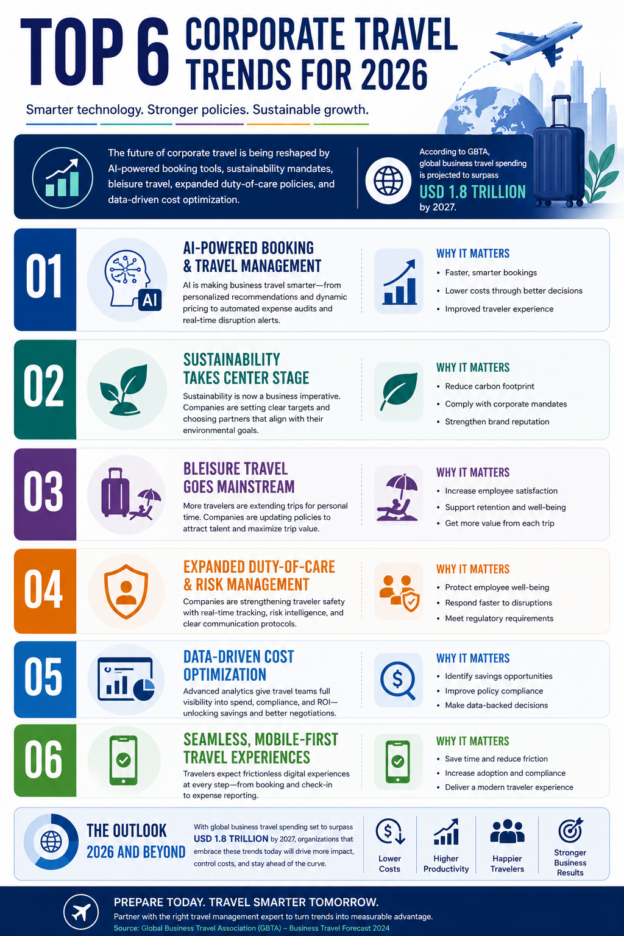
The future of corporate travel is being reshaped by AI-powered booking tools, sustainability mandates, bleisure travel, expanded duty-of-care policies, and data-driven cost optimization. According to the Global Business Travel Association (GBTA), global business travel spending is projected to surpass USD 1.8 trillion by 2027, making strategic preparation essential for organizations of every size. 

Introduction 

Corporate travel is entering a transformative decade as technology, climate accountability, and evolving employee expectations redefine how organizations move people across the globe. Govan Travels has observed these shifts closely, helping enterprises adapt travel programs for an industry that no longer rewards business-as-usual thinking. From AI-driven itinerary planning to carbon-conscious procurement, the next phase of corporate travel demands smarter strategies and forward-looking policies. 

What is the Future of Corporate Travel in 2026? 

Corporate travel in 2026 looks dramatically different from its pre-pandemic form, with hybrid work models, digital booking platforms, and personalized journeys taking center stage. A 2024 Deloitte Corporate Travel Study found that 79% of travel managers expect spending to match or exceed 2019 levels by 2026. Business trips are becoming more purposeful, focusing on high-value client meetings, conferences, and team-building events. The emphasis has shifted from frequency to value, where each trip must demonstrate clear ROI. 

How is Artificial Intelligence Transforming Business Travel Management? 

Artificial intelligence is automating everything from booking and expense reporting to predictive risk analysis across the corporate travel ecosystem. According to a 2024 McKinsey report, AI tools can reduce booking time by up to 60% while personalizing every itinerary. 

Key AI applications shaping corporate travel include: 

  • Smart booking assistants that recommend optimal flights and hotels based on traveler preferences 
  • Predictive analytics that forecast travel costs and disruptions 
  • Automated expense management that scans receipts and categorizes spending 
  • Real-time chatbots that provide 24/7 traveler support and rebooking 
  • Risk intelligence platforms that monitor geopolitical, weather, and health alerts 

AI adoption is no longer optional for companies aiming to streamline operations and improve traveler satisfaction. 

Why are Sustainability and Green Travel Becoming Corporate Priorities? 

Sustainability has become a non-negotiable factor in corporate travel as organizations face mounting pressure from regulators, investors, and employees. The European Union’s Corporate Sustainability Reporting Directive (CSRD) now requires large companies to disclose Scope 3 emissions, which include business travel. 

Sustainable corporate travel practices gaining traction include: 

  • Choosing direct flights and rail alternatives where feasible 
  • Booking eco-certified hotels with verified green credentials 
  • Offsetting unavoidable emissions through reputable carbon programs 
  • Replacing low-ROI trips with virtual or hybrid meetings 
  • Tracking emissions through integrated travel management platforms 

Green travel policies are quickly becoming a measurable ESG benchmark for global enterprises. 

What are the Top Bleisure Travel Trends Companies Should Watch? 

Bleisure travel, the blending of business and leisure trips, has surged as employees seek more flexible and rewarding work experiences. A 2024 American Express Global Business Travel report revealed that 76% of business travelers extend trips for personal leisure when policy allows. Forward-thinking organizations are updating policies to permit weekend add-ons, family-inclusive bookings, and remote work days at the destination. This trend strengthens employee retention while making corporate travel more attractive across generations. 

How Can Companies Improve Traveler Safety and Duty of Care? 

Duty of care has expanded well beyond emergency response, now encompassing physical safety, mental wellness, and cybersecurity for every traveling employee. The ISO 31030:2021 Travel Risk Management standard provides a globally recognized framework that more organizations are formally adopting. 

Modern duty-of-care practices include: 

  • Real-time traveler tracking with consent-based location services 
  • Pre-trip risk assessments tailored to destination and traveler profile 
  • 24/7 emergency assistance through dedicated travel management platforms 
  • Mental health resources and jet-lag management support 
  • Cybersecurity briefings for travelers handling sensitive data 

A robust duty-of-care framework protects both employees and corporate reputation.

What Cost Optimization Strategies Will Define Corporate Travel? 

Cost optimization is evolving from basic supplier negotiation into data-driven travel intelligence powered by analytics and benchmarking tools. The GBTA 2024 Business Travel Index reports that companies using consolidated travel management platforms save an average of 15-20% on annual travel spend. Dynamic pricing, preferred-supplier programs, and automated policy-compliance tools are reshaping how budgets are managed. Smart cost control now balances savings with traveler experience to ensure long-term program sustainability. 

References 

  • Global Business Travel Association (GBTA) Business Travel Index Outlook 2024 
  • Deloitte 2024 Corporate Travel Study 
  • McKinsey & Company: The Future of Business Travel Report 2024 
  • European Commission: Corporate Sustainability Reporting Directive (CSRD) 
  • ISO 31030:2021 Travel Risk Management Guidelines 
  • American Express Global Business Travel 2024 Trends Report 
Corporate Travel Mistakes That Cost Companies Thousands and How to Avoid Them

How Govan Travels Redefines Corporate Travel With Tailored Solutions

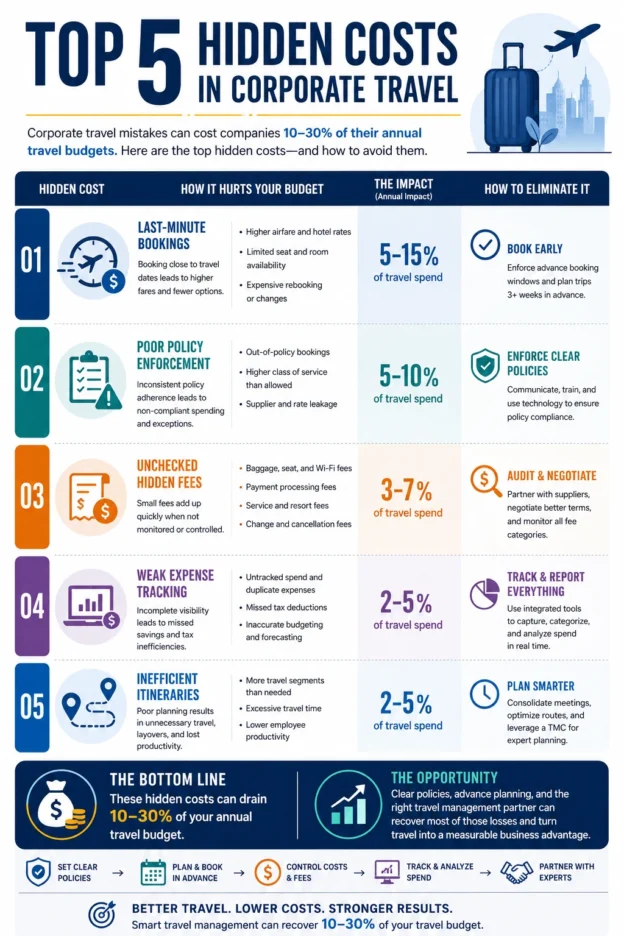
Corporate travel mistakes such as poor policy enforcement, last-minute bookings, unchecked hidden fees, and weak expense tracking can cost companies 10 to 30 percent of their annual travel budgets. Clear policies, advance planning, and the right travel management partner can recover most of those losses and turn travel into a measurable business advantage.

Business trips fuel growth, but they also burn through budgets faster than most finance teams realize. According to the Global Business Travel Association (GBTA) Business Travel Index Outlook, global business travel spending crossed USD 1.48 trillion in 2024, with a meaningful share lost to avoidable inefficiencies. Govan Travels has observed how minor booking oversights quietly snowball into six-figure annual losses across mid-sized Indian enterprises. Knowing the common pitfalls before approving the next trip protects both budgets and employee productivity. 

What are the Most Common Corporate Travel Mistakes? 

Most organizations repeat the same handful of errors that quietly inflate corporate travel spend each quarter. Recognizing these patterns early is the first step toward fixing them. 

  • Booking flights and hotels too close to departure dates 
  • Allowing employees to bypass approved corporate travel policies 
  • Skipping travel insurance for international trips 
  • Failing to track receipts and expense reports in real time 
  • Ignoring loyalty programs and pre-negotiated corporate rates 

These small oversights add up quickly, often costing mid-sized firms upwards of INR 10 lakh in preventable losses each financial year. 

How Much Do Poor Travel Decisions Cost Companies Each Year? 

A Deloitte study on corporate spending found that organizations lose between 10 and 30 percent of their travel budgets to inefficient booking practices and policy non-compliance. For a company spending INR 2 crore on annual travel, that translates to INR 20 to 60 lakh in avoidable losses. The hidden cost extends beyond cash, since rushed bookings often mean longer layovers, missed client meetings, and exhausted employees who underperform during critical engagements. 

Why Do Corporate Travel Policies Often Fail to Save Money? 

Most travel policies sit in shared drives, unread and outdated, while employees book through personal accounts for convenience or reward points. Research published in the Harvard Business Review notes that policies without enforcement mechanisms typically deliver less than half of their projected savings. Vague guidelines around cabin class, hotel star ratings, and meal allowances create grey zones that drive up reimbursements. A clear, regularly refreshed, and digitally enforced corporate travel policy is the difference between a document and a real cost-control tool. 

What Hidden Fees Drain Corporate Travel Budgets the Most? 

Sticker prices on flights and hotels rarely reflect the final invoice. Several add-on charges quietly inflate corporate travel costs across nearly every trip. 

  • Last-minute change and cancellation penalties 
  • Baggage and seat selection fees on budget carriers 
  • Hotel resort fees, parking, and in-room Wi-Fi charges 
  • Foreign exchange markups on corporate credit cards 
  • Ground transport surge pricing during peak hours 

A quarterly audit of these line items often surfaces savings worth several lakhs that finance teams previously wrote off as fixed costs. 

How Can Businesses Reduce Last-Minute Booking Costs Effectively? 

Data from the Airlines Reporting Corporation shows that domestic airfares booked within seven days of travel can cost up to 70 percent more than fares booked three weeks in advance. A centralized booking calendar, mandatory advance approval windows, and pre-negotiated corporate rates with airlines and hotel chains dramatically cut these surcharges. Pairing internal discipline with a travel management partner that monitors fare drops adds a second layer of measurable savings. 

What Should Companies Look for in a Corporate Travel Partner? 

The right corporate travel partner does more than book tickets, acting as a cost-control and risk-management extension of the finance team. Choosing carefully prevents recurring budget leakage. 

  • 24/7 emergency support across time zones 
  • Pre-negotiated corporate rates with airlines and hotel groups 
  • Real-time expense reporting and policy compliance tools 
  • Duty-of-care services and traveler safety tracking 
  • Transparent fee structures with no hidden markups 

A travel partner aligned with company goals turns corporate travel from a quarterly cost headache into a strategic business asset. 

References 

  • Global Business Travel Association (GBTA), Business Travel Index Outlook 2024 
  • Deloitte Insights, Corporate Travel Study on cost leakage and policy compliance 
  • Harvard Business Review, research on enforcement and savings outcomes in corporate travel policies 
  • Airlines Reporting Corporation (ARC), data on advance-purchase airfare pricing trends